
6 Days Climbing
Kilimanjaro Machame Route
Overview
Machame Route:
Kilimanjaro climbing 6 days Machame Route, the so-known as “Whiskey” route which means challenging route Climb Kilimanjaro 6 days, Machame the best route. It is the second most popular and one of the most scenic routes on the mountain. All climbers sleep in tents (tents are included) and meals are served in a dinner tent or on a blanket outside. It is done over 6 days, so acclimatization is easier, and the success rate is fairly high. It is for physically fit people with some hiking experience. Descent is down the Mweka trail staying at the Mweka or Millennium camp the final night on the mountain. Below is 6 Day Kilimanjaro climb-Macrame route itinerary.
Detailed Itinerary
Day 1: Machame Gate – Machame Camp
You will be picked up at approximately 8:00 am from your Lodge/Hotel and transferred to the Machame village where you begin the trek. From the Park entrance gate (Machame), you will walk for about two to three hours through a dense forest of fig and rubber trees, begonia flowers, and other tropical vegetation. A stop for a picnic lunch will be made halfway to this evening’s campsite. As you continue your ascent, you will find that the tropical forest has given way to tall grasses and giant heather. You will be walking on a ridge, to the left of which is the Semira stream, and on the right, the Weru Weru. Depending on the pace of the climbers, arrival at Machame Camp is usually between 5:00 PM and 6:00 PM. Your camp is set up near some old metal huts, which were once used for shelter. This initial stage of the climb is tranquil and relatively easy.
There is no point in rushing to get to the Camp, as there is little to do there. Guides tend to recommend a slow ascent, even at this point, for gradual acclimatization. Do not try to keep up with your porters, who will usually bind ahead. Instead, take time to admire the beauty of the rainforest dinner and overnight at Machame Camp (10, 000 ft)
Day 2: Machame Camp – Shira Camp
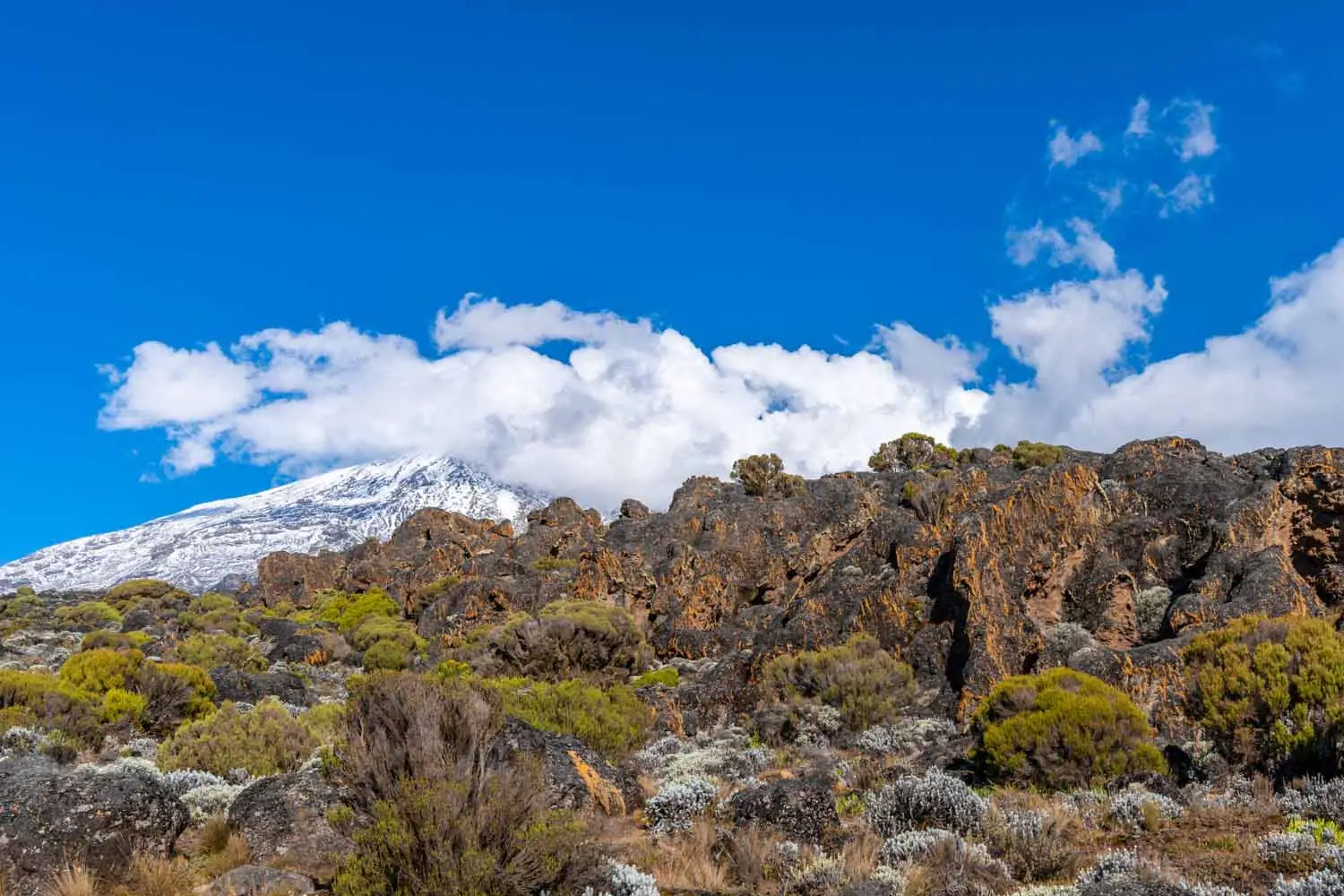
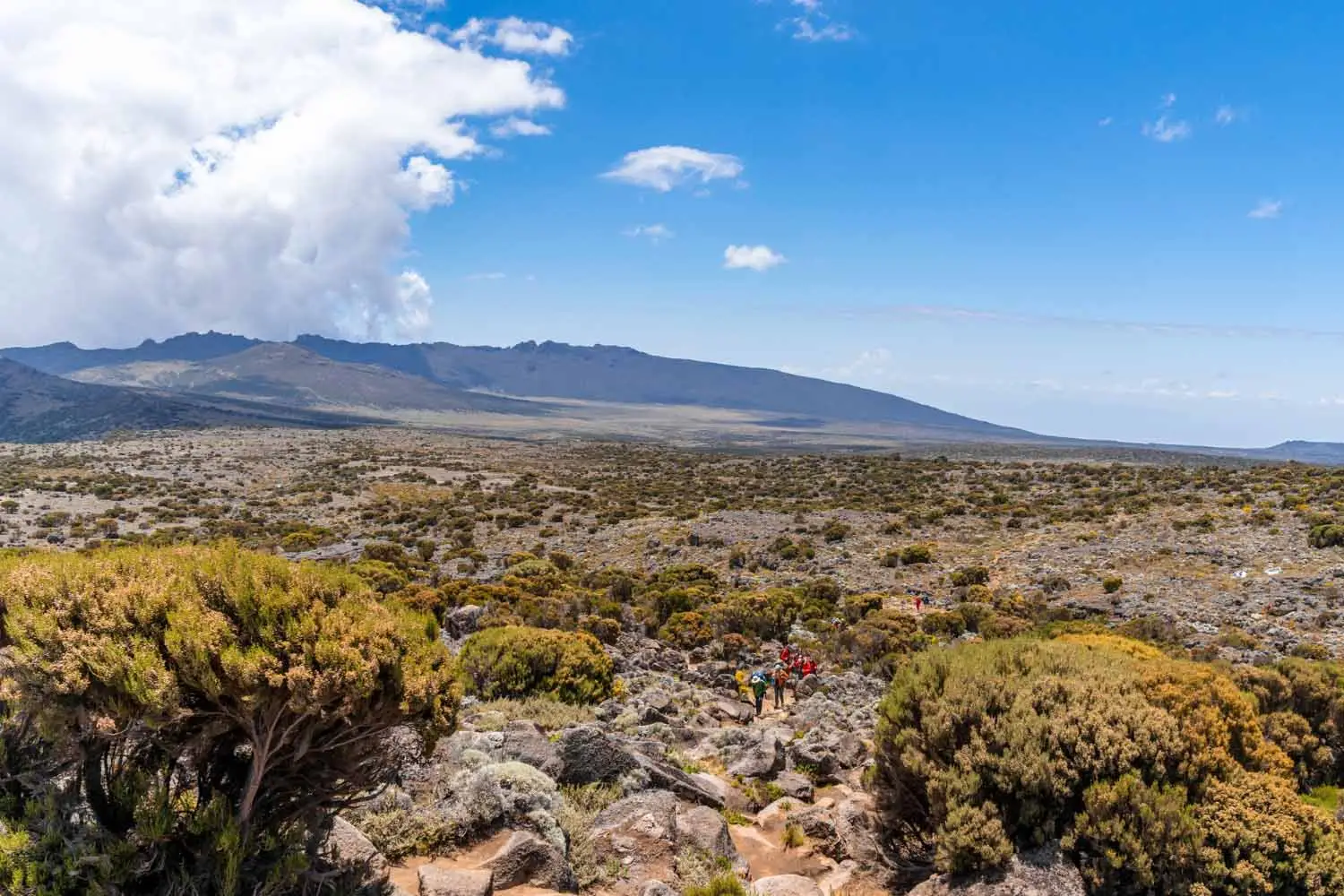
On this and subsequent mornings, the wake-up call is at around 6:00 AM. You will be greeted with a steaming cup of tea or coffee, and weather permitting, by a fabulous view of Uhuru peak. Today’s trek takes you up a steep track through a Savannah of tall grasses, volcanic rock, and bearded heather. You will encounter giant groundless as you hike through a ghostly landscape of volcanic lava, caves, and foamy streams. Lunch will be taken just below the Shira Plateau, about three to four hours from Shira Camp. The hike to the next campsite takes approximately six hours and you should arrive between 2:00 PM and 3:00 PM. Most climbers tend to pace themselves, walking slowly and resting about every half-hour. Dinner and overnight at Shira Camp (12,500 ft).
Day 3: Shira Camp – Barranco Camp
The entire Shira Plateau greets you this morning with sweeping vistas across to Meru and the Shira Needles. A steady walk takes you up to the pass at Lava Tower (15,000 ft), where you stop to have lunch. Crossing the Bastian stream, you will begin to descend toward Barranco Camp. The descent takes you along an immense canyon called Grand Barranco. Along the way, you will see numerous waterfalls, which are fed, by streams coming from the mountain, converging here to form the Umbwe River. Your camp is set at almost the same altitude as the night before. Today’s trek lasts for about six hours and arrival at camp is between 4:30 PM and 5:30 pm. Dinner and overnight at Barranco Camp (13,000 ft).
Day 4: Barranco Camp – Barafu Camp
This morning you begin your hike to Barafu Camp via Karanga Camp, which is at the same altitude as Barranco Camp. You will encounter a bit of a climb at Barranco Cliff and spend the rest of the trek climbing up and down the slopes of the mountain most of the way to camp. The climbing is not considered difficult and you should arrive in time for lunch (approximately 1:00 PM) having trekked for about four hours. In the afternoon you have to hike in the Karanga Valley where giant scenarios and Lobelia grow; then continue with the scenic climb to Barafu which is mostly on a moraine with a view of Mawenzi peak towering majestically to the right, and overhead, Kibo peak seemingly just out of reach. The alpine desert terrain encountered at this point is mostly a mineral environment with few lichens and mosses. Climbers arrive at Barafu Camp at around 3:30 PM. Climbers who choose to ascend the peak will go to bed very early this night, as the next day is the longest one. Overnight: Barafu Camp (15,200 ft). Ascent to Summit (19,430 ft) / Descent
Day 5: Barafu Camp – Summit (Uhuru Peak) – Mweka Camp
You will be awakened at midnight and after a light breakfast, start climbing at around 1:00 AM. It is at this stage that the climb becomes much more difficult. Here, very few will not be suffering from altitude sickness in some form or another; and climbers should carry as little as possible on this portion of the climb. Temperatures will range from -4° to 5° Fahrenheit. Making your way up a path that is flanked by the Ratzel and Rebman glaciers, you will climb for about six hours before reaching the edge of the crater, between Stella and Hans Meyer points. Another hour of climbing brings you to the summit. Uhuru stands at 19,340 feet and is the highest point on the continent of Africa. The track around the edge of the crater is rocky and icy. Concentrate on your feet, and follow your guide very closely for this portion of the journey. The descent is no easier than the ascent. You will reach Kibo Hut after about three hours (around 11:30 AM). Climbers will be given the opportunity to rest and have some refreshments before continuing on to Mweka Camp for the night. Arriving at camp at around 5:00 PM, you will have trekked a total of thirteen hours today. Dinner and overnight at Mweka Camp (10,200ft) Mweka to the gate.
Day 6: Mweka Camp – Mweka Gate – Moshi/Arusha Town
On the final day of the journey, climbers descend from Mweka camp to the base. The descent to the gate will take approximately 4 hours and climbers usually arrive before noon. Upon arrival at the gate, climbers will be rewarded with certificates attesting their success at climbing Mount Kilimanjaro then after you will meet your driver and he will drive to Moshi or Arusha town and drop you off at your Lodge/Hotel.
Accommodation
Budget Accommodation
Safari using affordable Hotels, Lodges, or Camps, comparable to a 1-2 star Hotel. Accommodation is usually located outside the National Park.
Mid-range Accommodation
Safari using medium to large–scale Lodges, tented camps, or Cottage Camps, comparable to a 3-star Hotel
Luxury – Accommodation
Safari using deluxe tented camps or Lodges usually located inside the National Park and comparable to a 4-star hotel. Accommodation is usually located inside the Park.
Luxury+ – Accommodation
Safari using extremely luxurious tented camps or Lodge, usually located in a private wildlife – Viewing area and comparable to a 5-star Hotel. Expect great food, excellent service, top-quality guiding, and gorgeous tents or rooms. Most luxury + properties charge around USD$ 850 to 1850 per person per night!
Includes & Excludes
- All Park entry fees
- Rescue fees/Hut fees
- Camping fees
- Pick up from the Airport
- Guide/assistant guide/Porters
- Overnight at the Huts/camps per the tour plan
- Meals as per the above itinerary prepared by our chef
- Park commission fees
- Transport to and from the gate
- 1-night free Hotel accommodation on your arrival in Moshi/Arusha with bed & breakfast
- Tent/Sleeping mats/Sleeping bags/chairs & table.
- International flights
- Domestic flights
- Fees for passports, visas, immunizations, and insurance
- Tips for staff such as guides/Chefs & porters.
- Expenses of personal nature (like souvenirs)
- Climbing gears (We have for rent)
Note (COVID-19)
“Please note that all these are sample itineraries. We will tailor-make your safari according to your wish and due to COVID-19 restrictions on travel around the world, it is free to postpone your travel up to 1 year after the original travel date”
Trip Navigate
Places:Kilimanjaro Machame Route
Let us tailor-make a safari suited to you.
This is just one example of a trip we could design for you. We tailor-make safari holidays that take you to Tanzania – no readymade tours or set departures. Get in touch today to start creating your bespoke itinerary